Resources and Advice
“To survive this [(2-3 years in)] period, you have to be willing to fail from the moment you wake to the moment your head hits the pillow. You must be willing to fail for days on end, for months on end and maybe even for years on end. The skill you accrete during this trauma is the ability to imagine plausible solutions, and to estimate the likelihood that an approach will work.” ~ https://matt.might.net/articles/successful-phd-students/
Organizing Literature
- I like using pen and paper for most of my work- literature reviews, planning etc.
- I find Zotero most helpful for building a literature repository. It integrates easily with Overleaf for quick citations and has a Chrome extension to efficiently save papers.
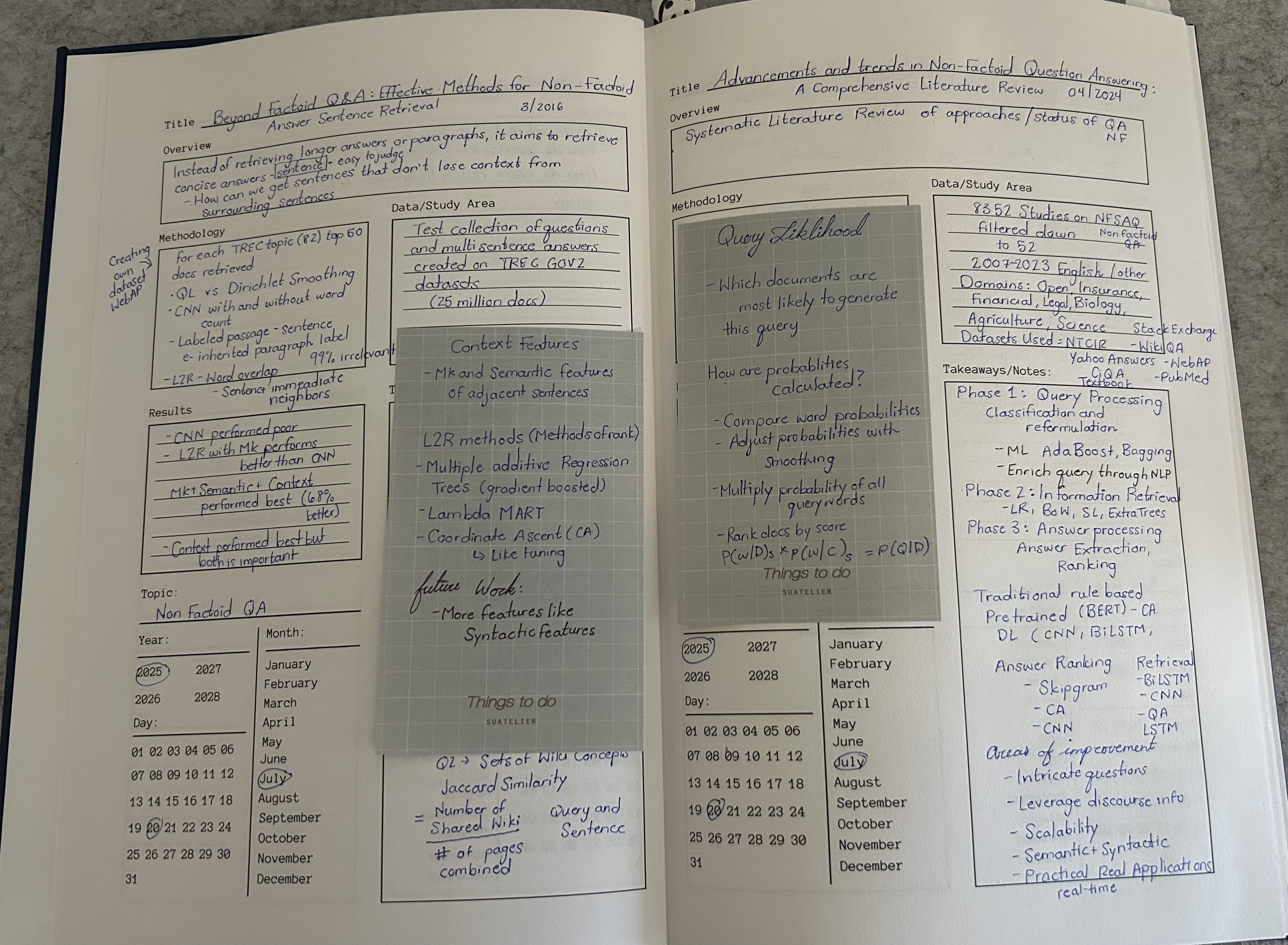
- I like Overleaf for drafting papers. I use Research Journal for collecting, organizing, and taking notes on literature review.
Writing my notes, especially in a limited amount of space, helps focus on the main points and takeaways.
Resources
- Mark Leone’s (CMU) Blog offers helpful advice on academic writing, research skills, and career development.
- How to write a scientific paper- nice tips for writing
- How to Write a Lot by Paul J Silva
- The Slow Science Manifesto
- Communicating Science to Nonscientists
- Resources for Students by Fredo Durand
- “Science is as much an act of persuasion as it is an act of discovery.” ~ https://matt.might.net/articles/successful-phd-students/
Research Ideas and Miscellaneous
- Find the time of day in which you are most productive e.g., To me, early mornings, when the whole world is quiet, dim, and full of hope, are to be exploited.
- Remove distractions- whether physical or mental
- Present your work in multiple formats: a poster, slide deck, short paper, long-form paper, or talks. Each method of dissemination makes you revisit your process in a new way, revealing new things in your reasoning, sharpening your argument, and identifying gaps- it is a form of repitition.
- Reflect on work, feedback received, classes, and experiences. Along with this idea, keep a (written) record of everything. Why a particular method was chosen, hyperparameter choices, why certain coding or stylistic decisions were made. It is my opinion that research hinges greatly on reproducibility. Providing explanation and documentation on thought process thoroughly can help yourself in the future as well as other researchers.
- While it may seem rudimentary, having checklists for methodology or assignments as a step by step guide on what to do each day or that walk through the steps of your research project process has been very beneficial for me.
- I like this project planner. A5 Roterfaden Taschenbegleiter. It can track up to 22 projects. Each project gets a two-page spread with a timeline across the top, a to-do list on the right edge, and a dot grid note section taking up the rest of the space.